Showing posts with label plants. Show all posts

Tuesday, February 14, 2017

False Spring is Still Spring, More or Less

Every year Albuquerque has a false spring. Right around Valentine's Day it gets really nice and warm. Everyone yearns to go outside. Plants everywhere bloom and I get hit by the first wave of allergies for the year.


The past two weeks have been sunny, in the 70s, and beautiful. I was sneezing my head off. Then, yesterday and today, it snowed. There goes this years false spring.


The best thing about the false spring is that it reminds me that it's time to plant peas. It's actually a little early for Albuquerque but mid-February is definitely pea planting time down in Las Cruces, where I picked up the habit. Sometimes you can get away with it in Abq. The first planting of the year. The beginning of the gardening season. I love it.


So this afternoon Little Digger and I went out and planted a row of Sugar Snap Peas along the back of the apple bed. Hopefully, they'll sprout and wind their way up the chainlink wall of the chicken pen that presses up against the bed. If the chickens don't peck them to pieces first, we'll have fresh, sweet peas in a few months.


While I was out there, I noticed that a few plants in my garden were fooled by the false spring. Day lilies are peeking their heads through the mulch in a few places, as are the Hollyhocks we planted last year. Maybe they'll actually produce a few flowers this time around! The herbs all seem to have overwintered pretty well. We even have a couple strawberry plants that seem to have survived!

I am so excited for this year.

Tuesday, May 13, 2014

A Garden Again

Following the planting of the trees, we've been excited about growing things again.  Before we add other trees, while we wait for evidence that we can actually grow a tree, there is a whole garden bed begging to be planted with something, anything.  When soft dirt beckons, it's impossible not to pick up a trowel and heed it's loamy call.
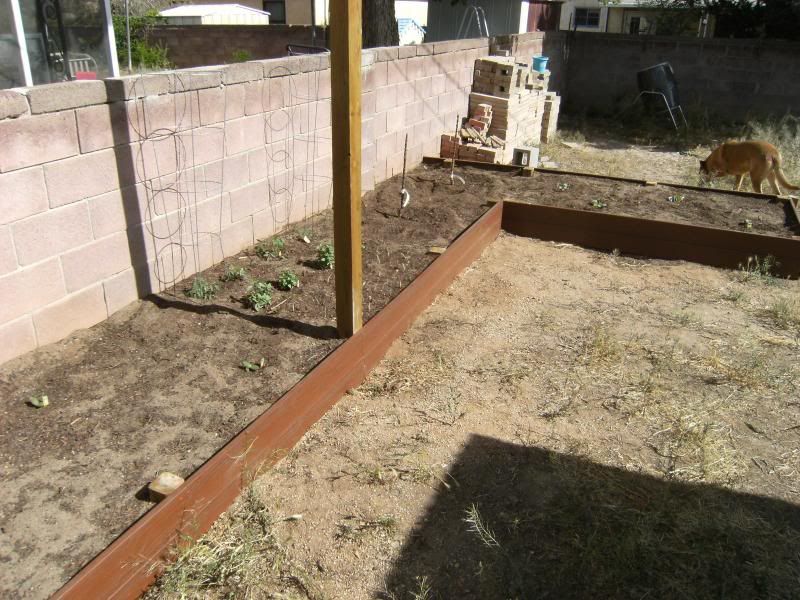
And so, of the weekend, plants were planted.  In any of my previous gardens, this many plants would have filled all the available space nicely, even as little baby plants.  In our new giant garden bed, they hardly show up in the photo.
Hopefully, they'll fill in a bit.  Specifics and lots of photos after the break.

Monday, May 9, 2011

Fortunately*

Unfortunately I was sick all last week and my loyal readers were deprived of my garden updates.  Fortunately we have entered another beautiful month here in the sunny Duke City and I can, in one post, catch you all up on what's been happening in my garden.

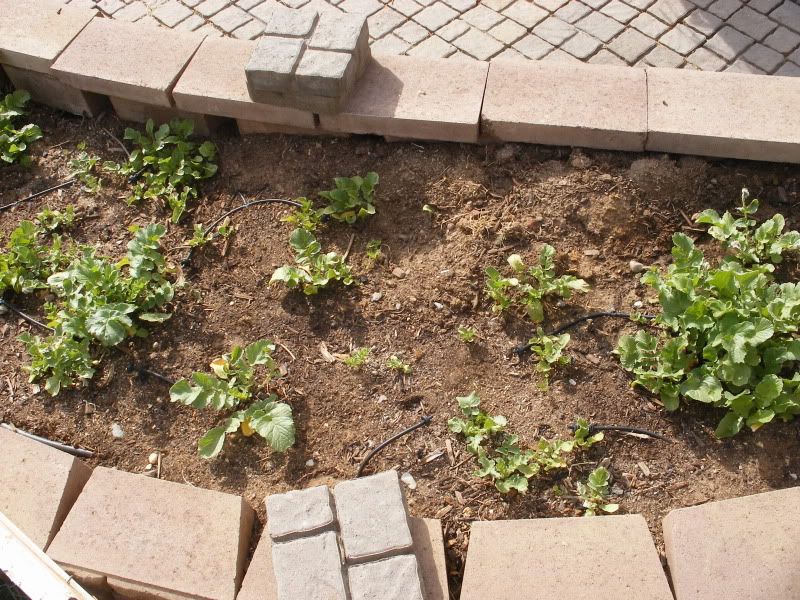
Fortunately my radish bed is full of beautiful foliage.  Lots of leafy radish greens and smaller carrot greens.  Unfortunately, if I poke my fingers around the base of the radishes, I'm not finding any plump tap roots.  It maybe that, as last year, I grow lots of radish plants but still have a disappointingly small harvest.  According to Mr Brown Thumb this could mean that both my garden beds in the past two years have lacked in phosphorous and potassium.  Additionally, the radishes have run out of time.  As per my agreement with my mother-in-law, it's time to empty this bed of vegetables and fill it with flowers for my sister-in-law's graduation party.  Fortunately, the carrots are small and cute.  I may sneakily leave them in the bed and plant flowers around them.  If I'm lucky the carrots will pull through in ways the radishes didn't.

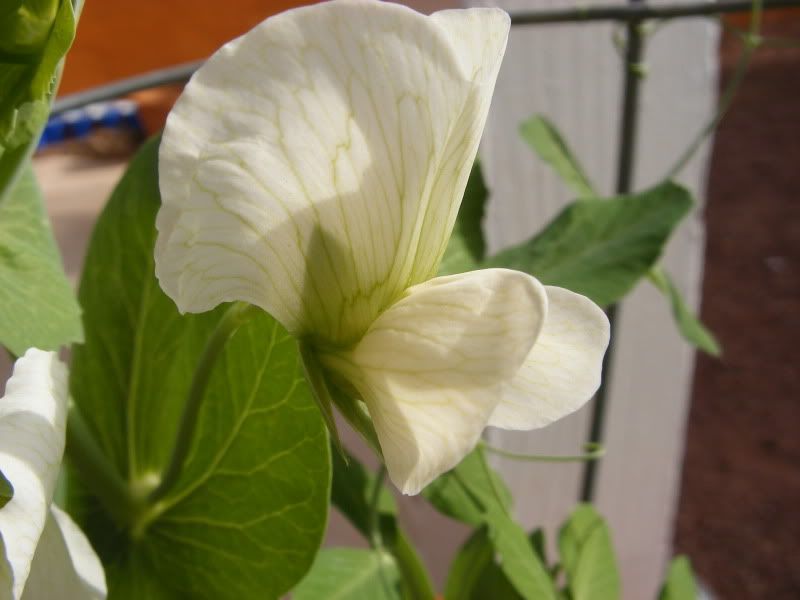
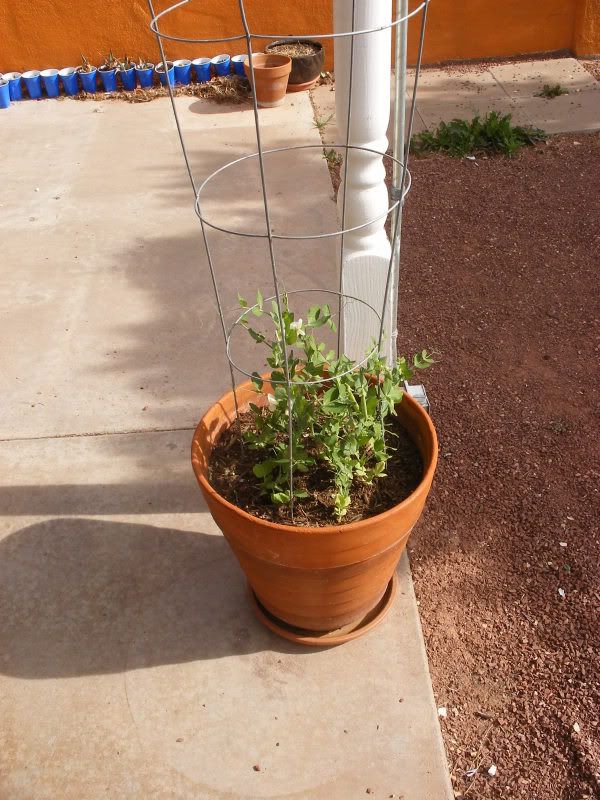
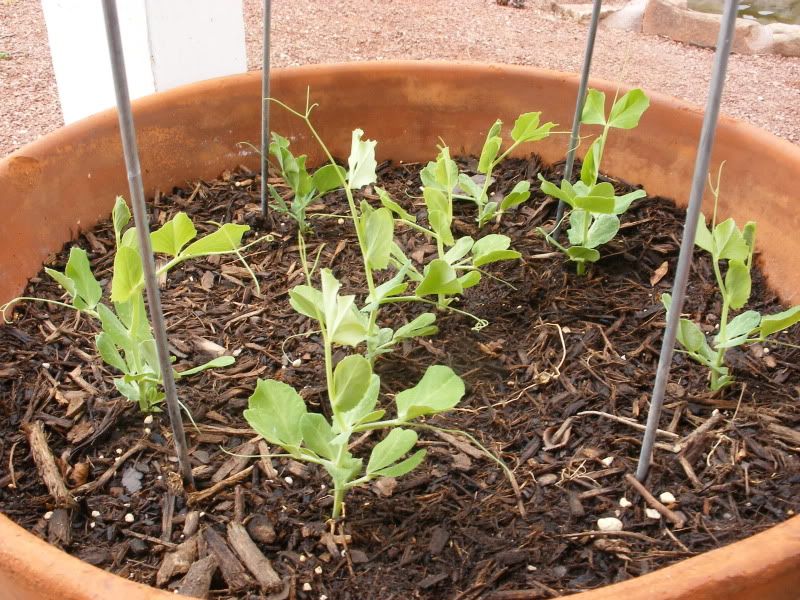
Unfortunately, the pea pots are another mixed bag.  The plants have not grown as much as I would expect, remaining about a foot and a half tall.  I assume this is because I planted them rather late and the weather is too warm for them.  They really haven't made much use of the tomato cage I so thoughtfully put in the pot for them.  Fortunately, they're still going to produce something!  They are cute pea flowers and even some peas all over their diminutive vines.  We'll get some fresh peas before cucumber plants take their place.
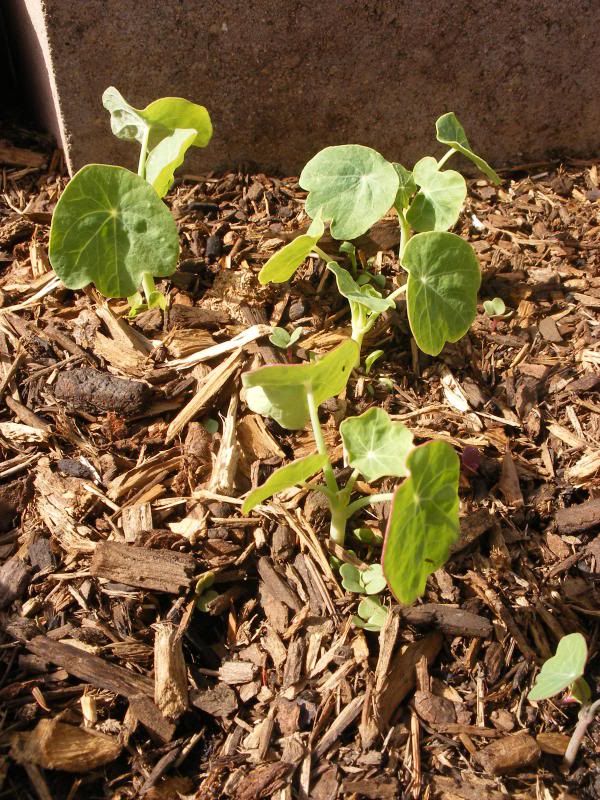
                                                                            Fortunately, the Nasturtiums are coming along fine.  While they do wilt a bit when they're thirsty, they bounce back better than I expected they would.  I expect that in another month and a half or so they're going to be big beautiful plants.  Unfortunately they're also out of time.  That bed too needs to be filled with flowers by the end of the month instead of filled with small vines that might eventually produce some flowers.  I will probably end up buying a flat of snap dragons to fill in the bed, leaving as many Nasturtiums as I can.  I really really want to eat a Nasturtium flower.


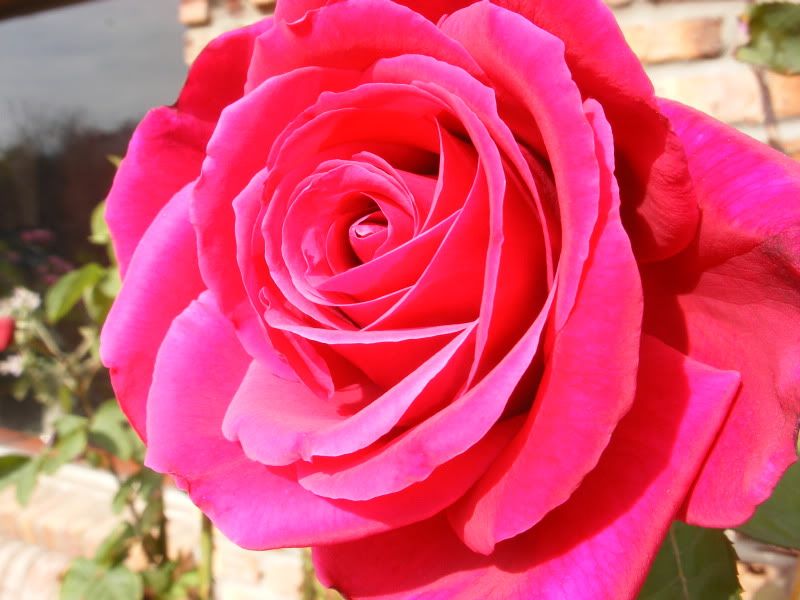
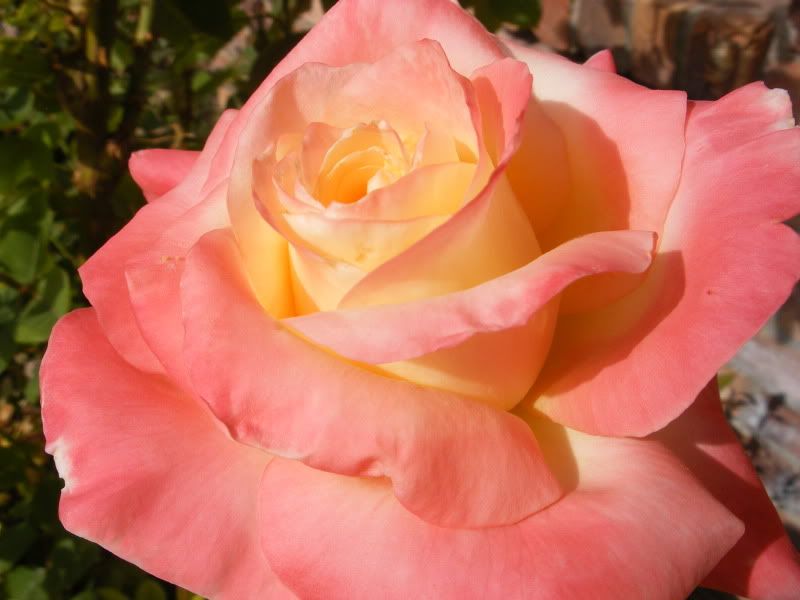
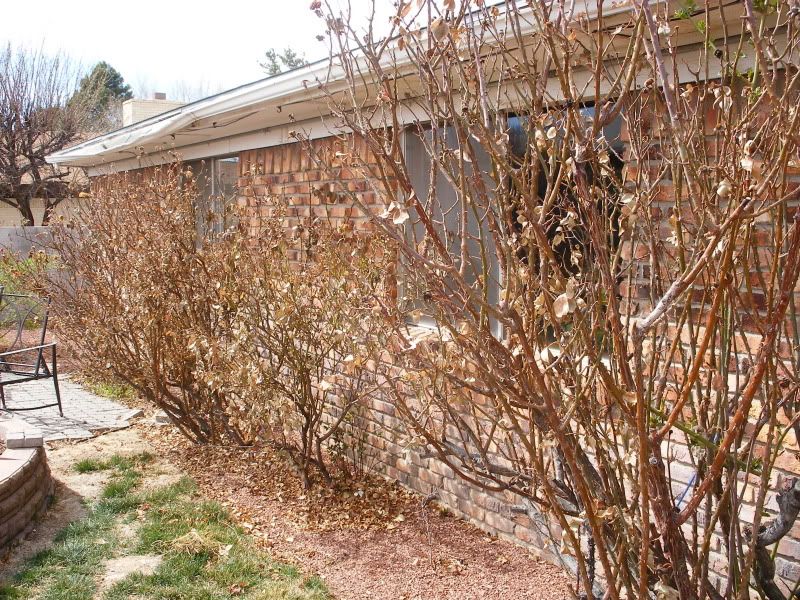
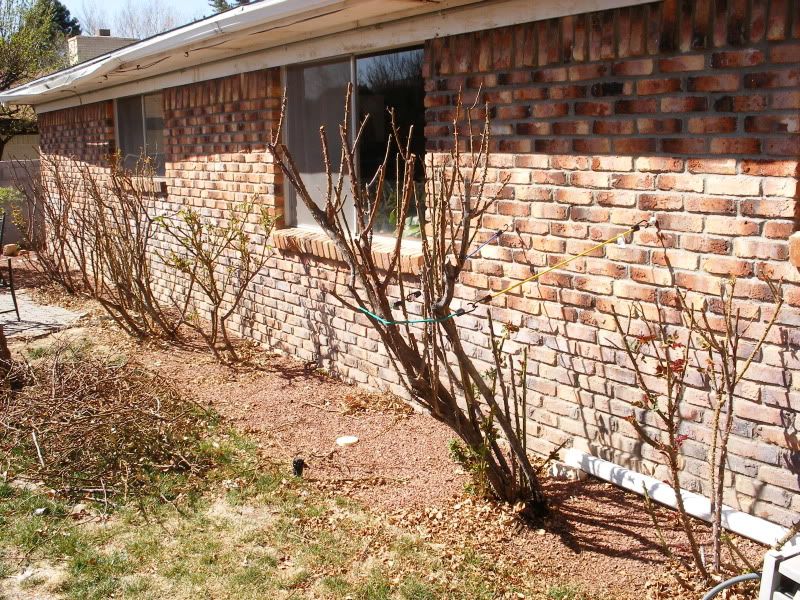
Fortunately, the roses have survived my pruning and are, for the most part, covered in lovely blooms.  The two biggest roses are causing some trouble by letting their old branches (that I so carefully pruned) die off and just sending up new growth from the roots.  And on one of them this new growth, though pretty enough and producing flowers, in trailing along the ground.  Which is weird.  Unfortunately, the successful blooms mean I have to start dead-heading which I have never been around to do before.  This means I've very likely to screw up.


*Since this post seemed to be full of mixed-bag type updates, I based the writing off one of my favourite picture books as a child.  I may not have been successful.

Monday, April 25, 2011

My Secret Garden

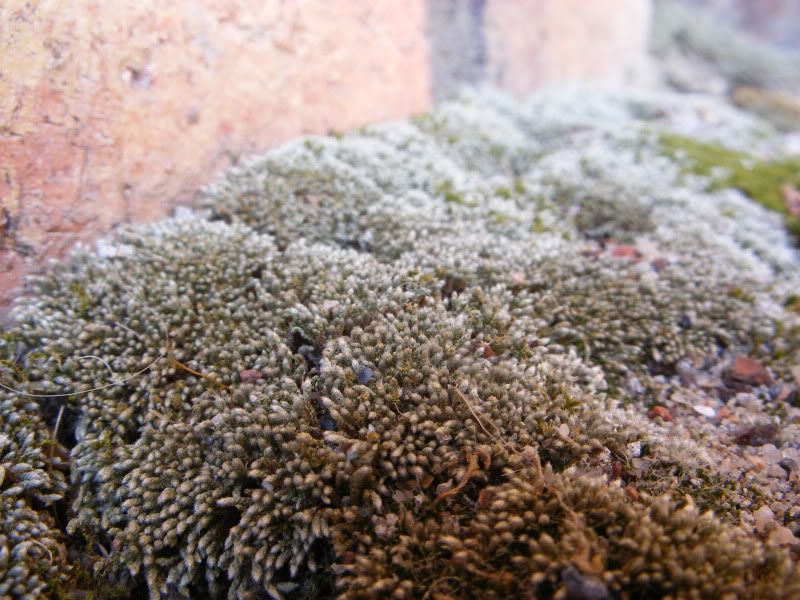
In addition to pruning roses for my in-laws, planting gardens for friends, experimenting with propagation, and planting some things of my own, I've been tending a secret garden that no one else knows about.  Well, tending probably isn't the right word.  I've just been watering it and admiring it.  I found it, around the side of the house, when I was situating my worm bin.  Can you see it?
It becomes a little more obvious if you step up onto a pile of brick.  You see, my secret garden is hidden from view, up above eye level.  That's why it's just mine.
Yes, it's just a pile of moss growing on the chimney.  For many of you, that might not be that special.  But many of you don't live in New Mexico.  It's too hot and dry for moss to really grow much around here.  The closest thing I frequently find get is the lichen that grows on my beloved Watermelon Mountains.  So finding a patch of fuzzy moss is a rare and special thing.
Of course, since it's a tiny garden filled with small non-vascular plants it helps to get up close to really appreciate it.  Moss is so interesting.  It's fuzzy and slightly squishy.  It comes in variety of textures and colors.
And then there are the "flowers".  When it spores the moss sends up little stocks which can look like flowers dotting a grassy hill.  The different kinds of moss even seem to send up different stocks.
Unfortunately this garden probably won't last the whole year.  I'm betting that even with my extra care it will get too hot this summer.  The moss will dry up and die.  My secret little garden will become a brown, barren place.  At least until fall or maybe next spring.  Then it will be cool enough and moisture will collect.  I'm sure at that point a new crop of moss will spring to life!

More Scraps

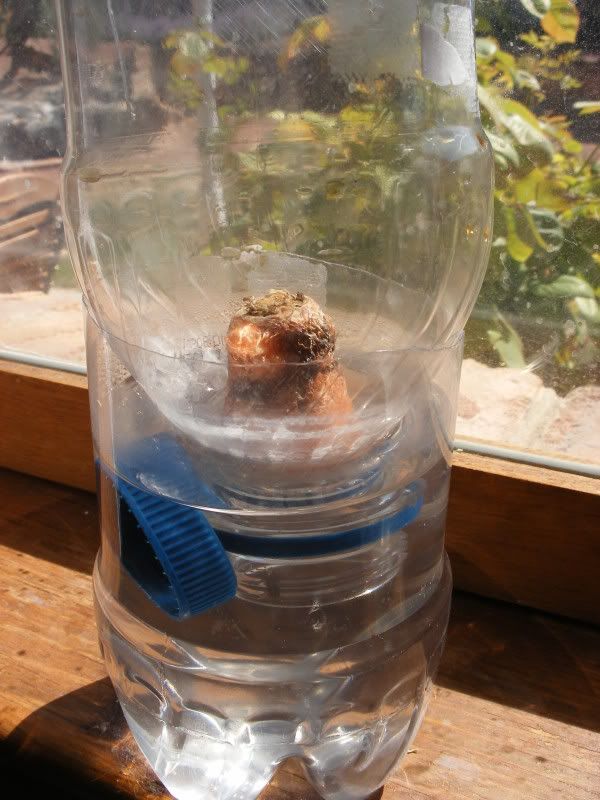
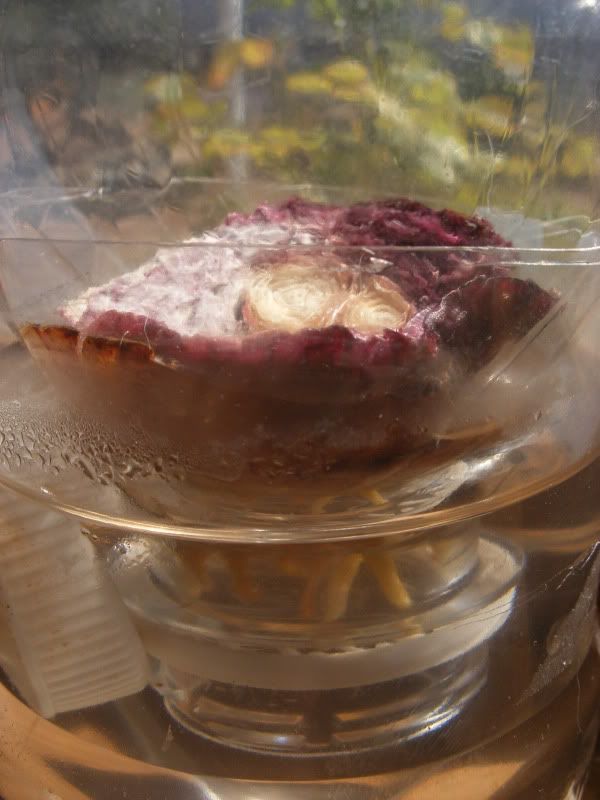
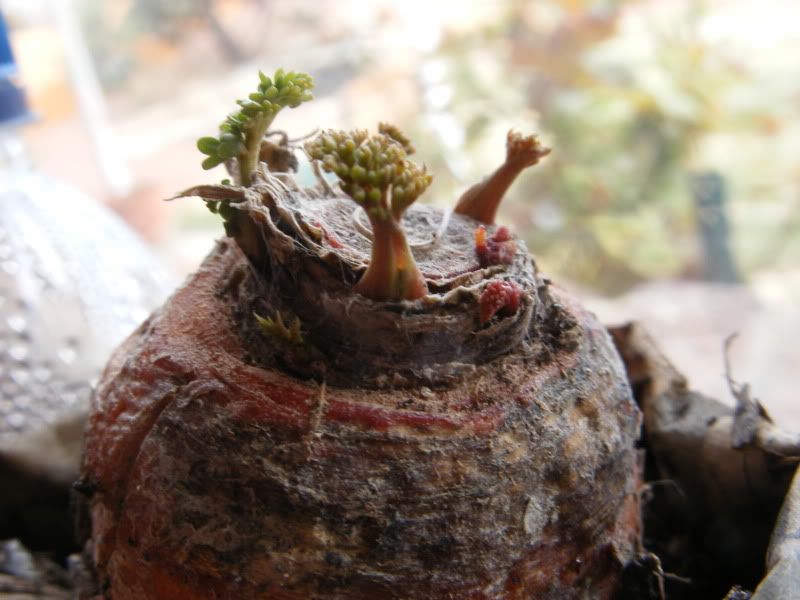
I just wrapped up another experiment in kitchen scrap propagation.  My subjects this time were an inch off the top of a carrot and an inch off the bottom of an onion.  Both vegetables were suspended in water in soda bottle greenhouses*, using the inverted top to hold them at the water's surface.  I can report one possible success and and one failure.

The carrot did not really show much growth.  There may have been a hint of leaf production but nothing substantial and no root development.  The portion of the carrot the remained submerged looked rather nice, though it had a mildly slimy texture by the end of the experiment.  The top portion of the carrot shrivelled up and discolored.  Next time I plan to keep just the stem part out of the water.  Next time I also need to find another way of suspending the carrot, as it kept tipping over in the bottle's neck when I changed the water.


The onion seemed to be growing.  There were, at least, roots forming, as seen in the photo.  There was no indication of top growth, suggesting that next time I need to leave more onion on the scrap.  The onion, too, would benefit from being suspended in a different way.  In this case tipping wasn't an issue but the outer layer of the onion that was in constant contact with the bottle began to rot.  The onion is buried in the carrot bed next to my mystery garlic.  We'll see if it survives being planted out and grows.


I probably would have allowed the onion to grow more before moving it but I need the green house for another experiment (seed starting for a three sisters garden).  Stay tuned for more scraps!


*I will have to make a post dedicated to these.  Probably in the fall when there aren't so many interesting growing things to post about.

Friday, April 22, 2011

Garden as Memorial

My grandfather, who's garden I have written about before, suffered a massive and unexpected heart attack and died recently.  I've spent the past two weekends down in the city of the City of the Crosses helping out my grandmother in any way I can.  I don't know if this is normal, but for our family that means yard-work.

I helped my father do some heavy pruning on a fig tree that suffered some damage this past winter.  I built row covers to keep rabbits out of the vegetable beds.  I helped tie back my grandmother's favourite rose to protect it from the 60 mph winds.  I did it all because I know it's what my grandfather would have been doing.

Nor was I the only one.  When the kids next door heard what had happened, they marched over, solemnly hugged my grandmother, and announced that they would weed her garden for her this summer.  It was touching how, after years of playing in the garden, they knew exactly how they could help.  They also swept her porch and planted seeds in a vegetable bed.

My grandfather once told me that two things in his life made him more proud than anything else.  First, that he had raised four good daughters.  Secondly, that he had positively impacted at least one plot of land.  He viewed his garden as a form of stewardship to the earth and liked to think that he had made a lasting mark, by improving the soil, in that area.

The garden was once one of his passions, a joyous project.  I hope that now it will continue to grow as a living memorial to him.  I hope that as my grandmother, myself, the kids, and other continue to tend the garden we will also be tending our memories of him.  I hope that neighbours walking past the garden will think of him.  I hope the garden continues to grow for a long time.

Wednesday, April 13, 2011

How Not to Grow a Carrot

This is just a quick update to my kitchen scrap gardening experiment.

I wanted to see if a carrot would regrow from a carrot top if it were placed in potting soil.  I put the potting soil in a newspaper pot to ease the transplant shock from eventually moving it out into the garden and contained the whole thing in a soda bottle greenhouse to keep it moist.  I set it on a sunny windowsill and waited.


I don't think, now, that this is the best way to grow carrots.  While there are some leaves beginning to emerge from the carrot, there are no roots and the the whole thing look and smells bad.  I suspect that the greenhouse is at fault, keeping everything a little too moist.

Time to try something new.

Friday, April 8, 2011

Garden Update: April Showers

Yesterday, in the aftermath of the first precipitation we've have in months, I went out to take stock of my little plants.  Most of them are doing great.  I'm suspect that this will be a good year.


There's nothing quite like peas.  They are the heralds of spring!  They grow before most of the other vegetables and the way the seem to stretch up toward the sky lift my heart.  There are about seven plants in each pot and as usual, I'm afraid I over planted a bit.  The peas in both pots seem to be doing great though.  A few of them have grabbed hold of the tomato cage I stuck in their pot.

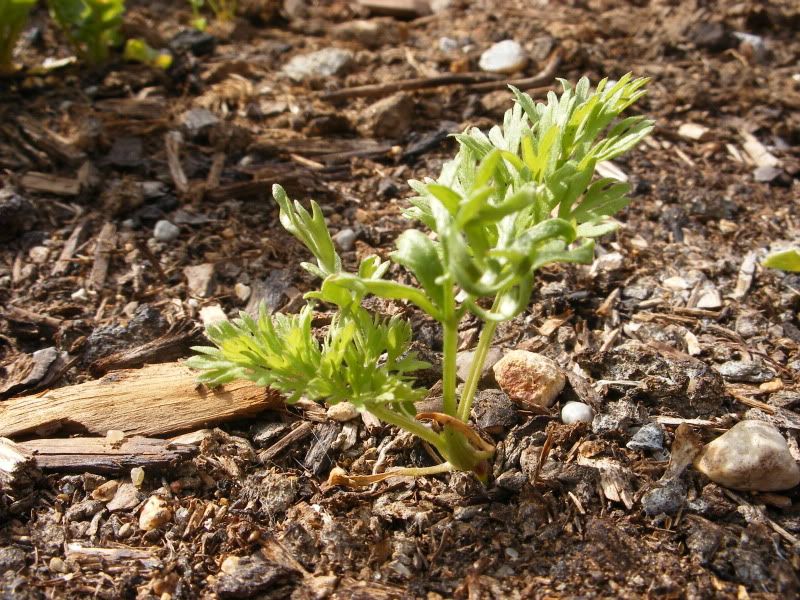
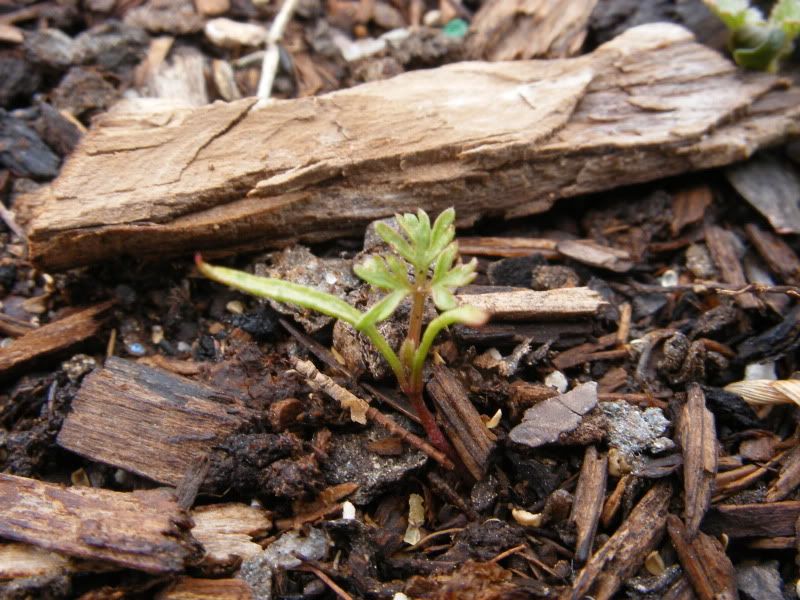
Carrot with round cotyledon.
Carrot with elongated cotyledon.
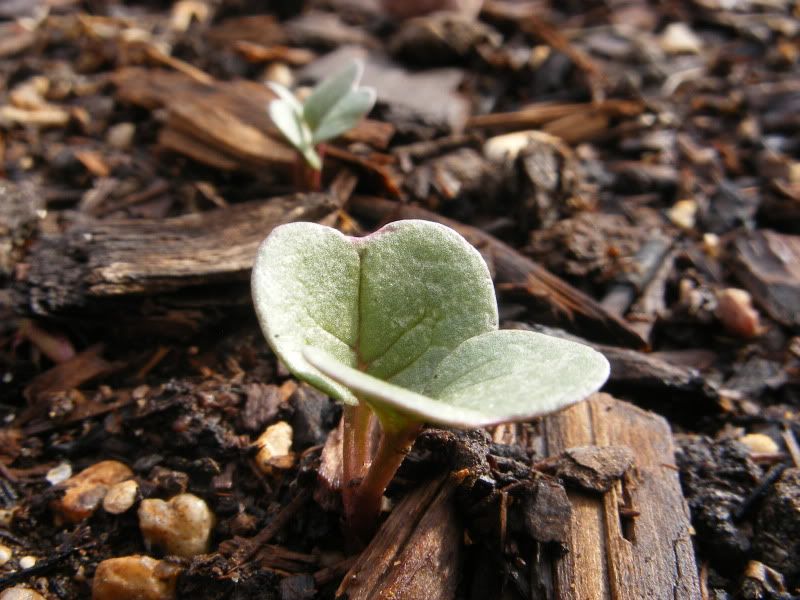
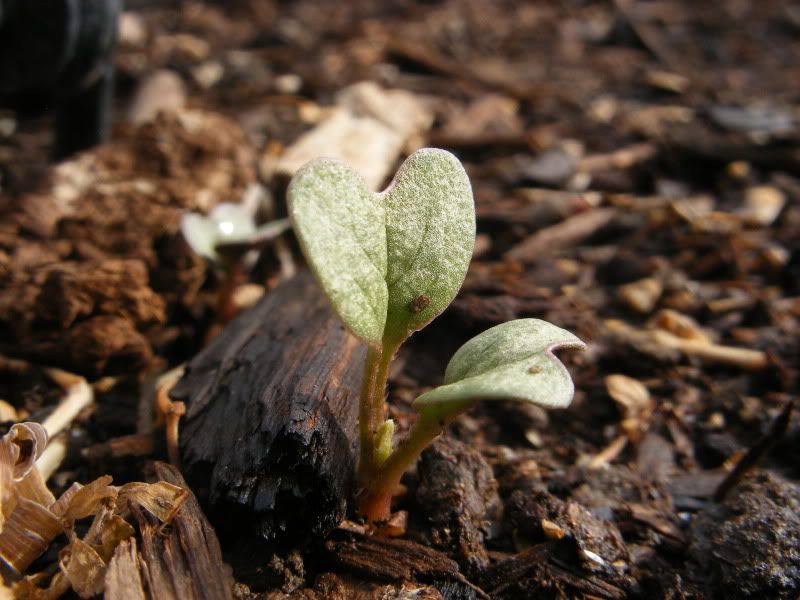
The radishes are doing great.  They're beginning to look like actual plants.  Time to thin out the dense spots a bit.  Even more exciting in this bed, the carrots have sprouted!  Back in my college garden I sowed carrots every year and only once got any to germinate so it's thrilling to have some success this year.  I planted a rainbow mix this year so I've been looking carefully for differences in the leaves of my carrot plants.  Some of them appear to have normal looking round cotyledon while others came up long and thin, like grass.  I only assume that they are both carrots because they both came up en masse at about the same time and they're both now sporting their first sets of true carrot leaves.  There's one other surprise in the radish-carrot bed.  Something came up with the radishes that is clearly neither a radish nor a carrot.  I let it grow because I was curious.  I don't know what my in-laws planted in this bed last year but it looks like a very large grass right now.  Any guesses?


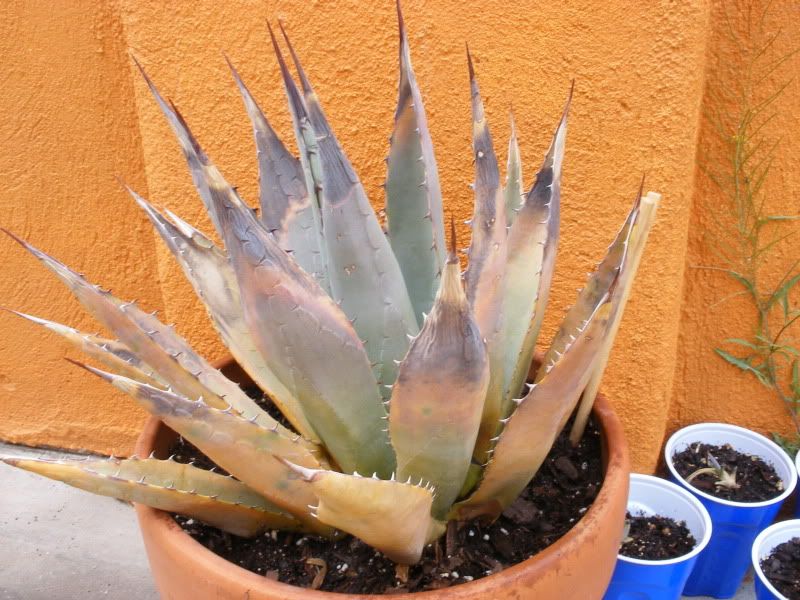
The agave that I repotted is not looking so good.  It, and most of it's pups, have lost their happy green-blue color.  Now it mostly matches the wall.  In the research that I've done since the repoting, it looks like I shouldn't have watered them all after I was finished and I should have left them under the porch instead of against a sunny wall.  Live and learn, I guess.  I'm still hoping that it's succulent constitution will give it the strength to survive.


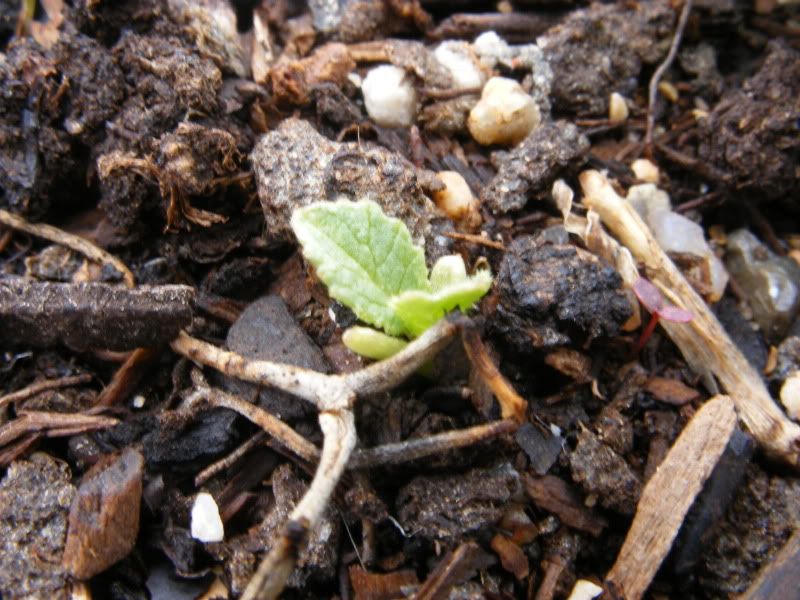
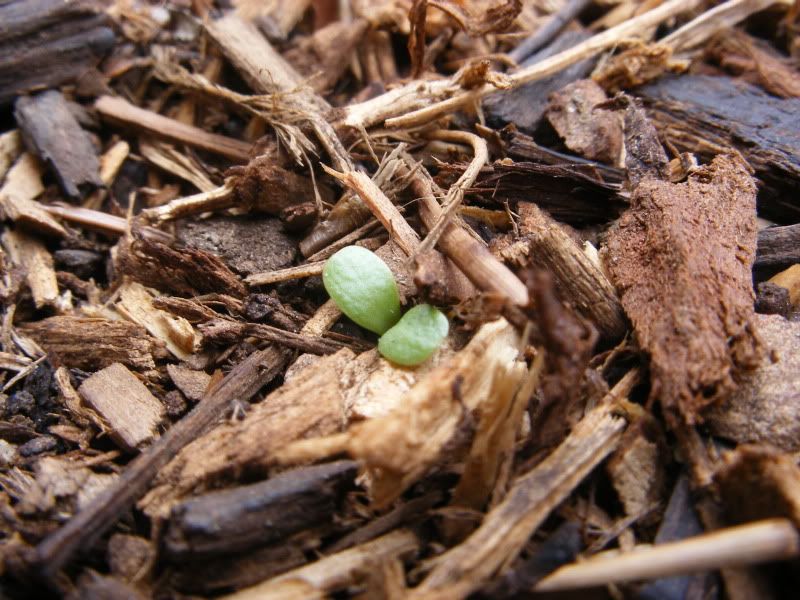
Lastly, two weeks ago I threw some seeds into the planter around the mailbox out front.  I didn't record the varieties and threw away the seed packets so I don't know exactly what I put in there.  I know there were some nasturtiums because, as I've said before, I'm curious how they do in our dry climate and I wish that everything I planted I could eat.  There were also some snapdragons because their color matched the nasturtiums and I know my mother-in-law likes them.  I also added in some sort of red lettuce for two reasons.  First, I thought the colored foliage would look nice with the flowers and secondly, I really like mixing flowers and vegetables.  The second reason goes against my mother-in-law's gardening ideas so I guess a minor act of rebellion is a third reason.  We'll see if she notices.  Yesterday, I noticed that something, one tiny little cotyledon, was poking out of the soil.  It is, of course, way to small and immature to identify so we'll just have to wait to see what's coming up out there.

What is it?

Wednesday, April 6, 2011

Kitchen Scrap Gardening?

Imagine for a moment that you've bought some carrots at the supermarket to make pot pies.  Most of the carrot, of course, gets diced up, cooked, and eaten.  If you're a gardener then the peelings should already be headed to you compost pile to be broken down into good stuff for your plants.  But if you really want to squeeze a little more usefulness out of that carrot, perhaps you can save the top and grow a whole new carrot!

This is a prime example of why I am, perhaps more than any other adjective, a frugal gardener.  Anything that I can acquire, repurpose, or make for free I will.

I remember first coming across this notion in an old children's book of projects*.  It suggested using both carrot tops in a tray of water and a sweet potato suspended in a glass to grow an indoor jungle.  I must have tried the carrot-in-a-tray idea a dozen times growing up but it never worked for me.  Usually the carrot dried out and the cat was blamed for drinking all the water.

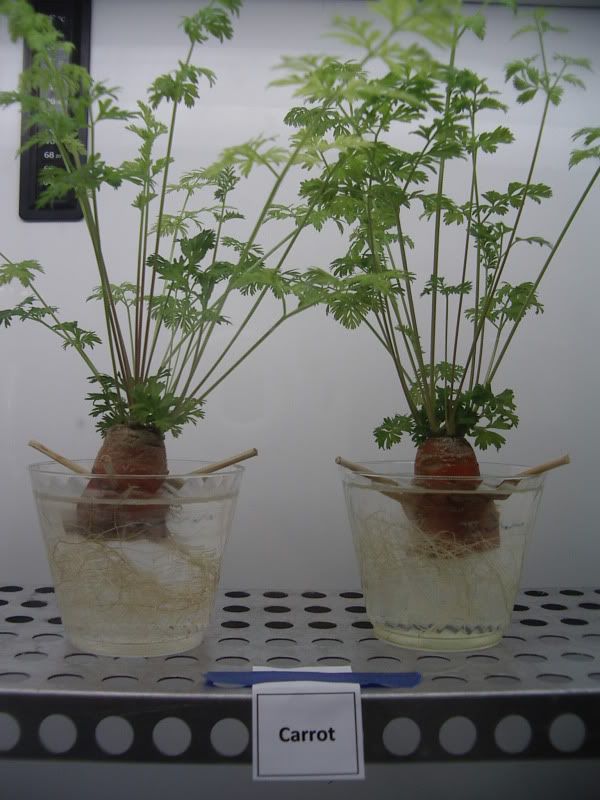
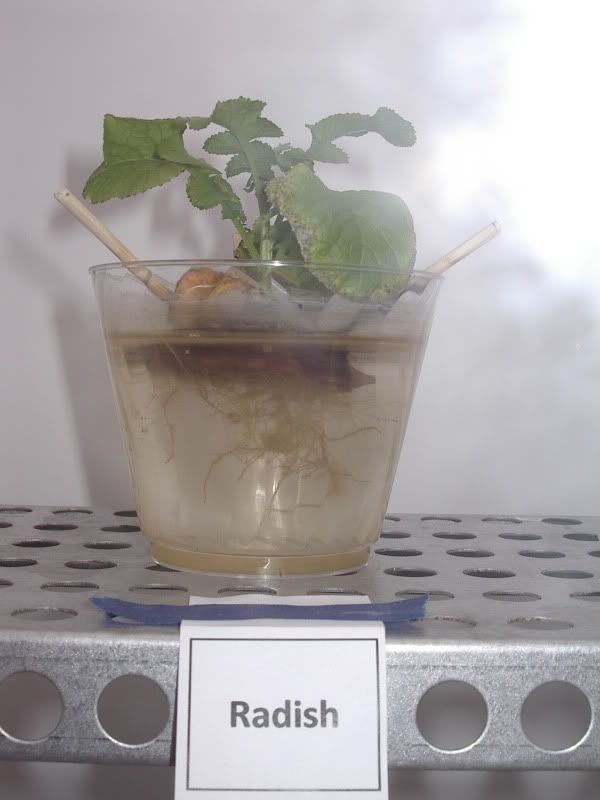
Now, however, I can now report some success!  In January I set up an experiment at a local children's museum to see if the tops of carrots (and some other, similarly structured vegetables) would grow in glasses of water.  All the samples were prepared similarly, with most of the root and any leaves removed before being suspended in a glass of water.  The water was refilled as needed and completely changed a couple of times a week.  Here are the results so far!

The carrots seem to be preforming best.  As seen in the photo, both carrots have lots of leaves and roots filling their cups.  It is important to note that the carrots in a manner very different to the other samples.  They produced roots fairly quickly (a week or two, I believe) but didn't put out any leaves for at least a month.

One of the two radishes is doing well.  It produced new leaves quickly, followed by root growth.  The other radish reportedly turned to goo within a week and was thrown out.


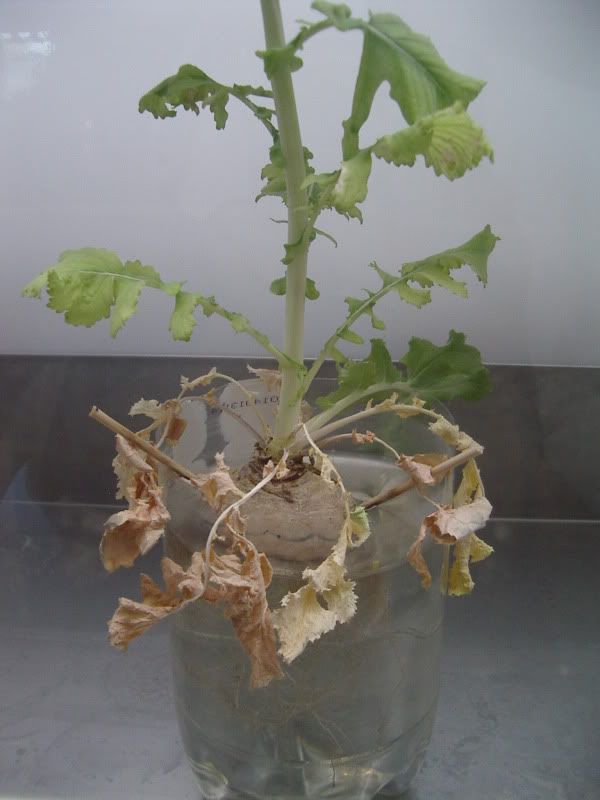
Only one of the two turnips is shown, though both turnip tops produced leaves and then roots.  The turnip shown quickly sent out lots of leaves and roots, followed by a tall stalk that now has small flowers at the top.  After two months some of the leaves it first produced started dying.

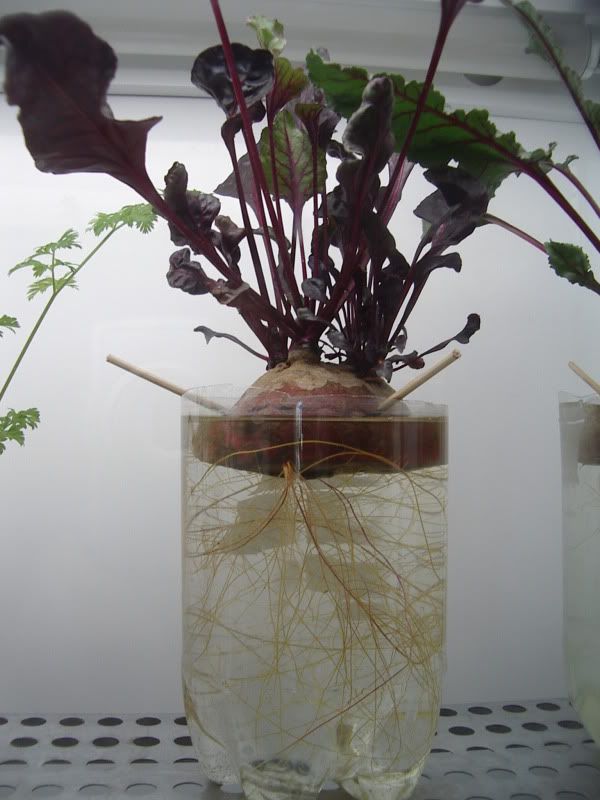
The beets needed to be watched closely.  For the first month they tended to leech red pigment into their water and grow a slime where they contacted the water.  This was regularly rinsed off.  The beet shown sent out leaves within a week followed by roots soon after.  The other beet grew leaves just as fast but didn't produce any roots until two months later.


While these results demonstrate that the discarded tops of root vegetables can grow new leaves and roots, they do not yet show that they are capable of regrowing the tap root that we would like to harvest (aside from the possibility of eating the turnip and beet greens).  Will these carrots ever produce a new carrot?  I don't know yet.

Other questions remain also.  Will the vegetable tops root in soil in addition to water?  What other vegetables can grow this way?  I have read that onions can be grown in a similar way from their discarded bottom ends.  I also remember reading somewhere that lettuce can grow again from their root ends.  Pineapples can supposedly be grown from their discarded tops, though I've never had any luck with this.  Avocados pits can, famously, be sprouted in a glass of water.  What other grocery store produce can yield good seed?


*On a side note, if anyone can remember the title of that book, I would love to know.  I remember it being illustrated in a style similar to P.D. Eastman, if that helps.

Friday, April 1, 2011

Repotting an Agave

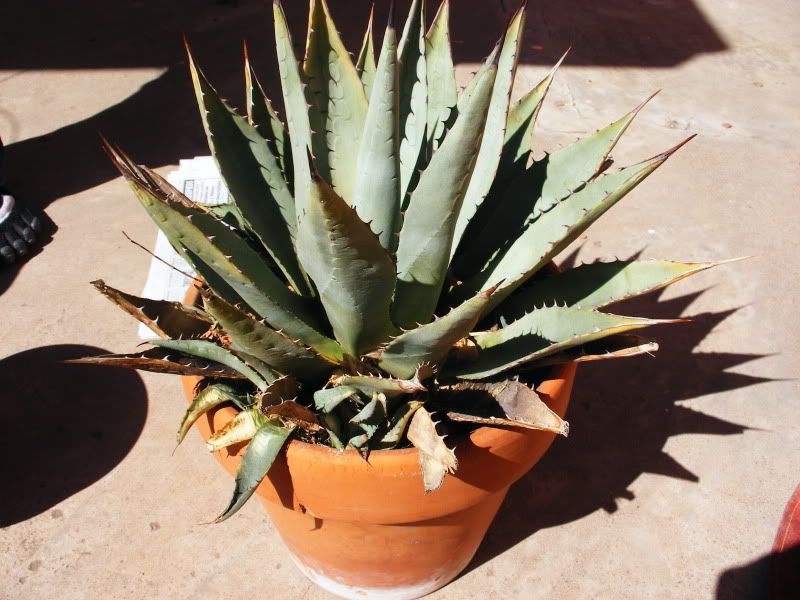
Of all the things the previous occupant of my last apartment left behind, my favourite was a potted Agave.  I've never had much luck with potted plants and never seen much point in plants that aren't useful but the Agave was looked pretty and hardy and was free.  Unfortunately, judging by the pups squeezing their way out from under the parent plant, the Agave needed to be repotted.


This chore scared me in a number of ways.  I have very little experience with repotting plants, so the odds of killing it in the process seemed high.  Furthermore, the Agave is a large, spiny, dense plant so the odds of injuring myself seemed equally high.  So I put it off for a year.
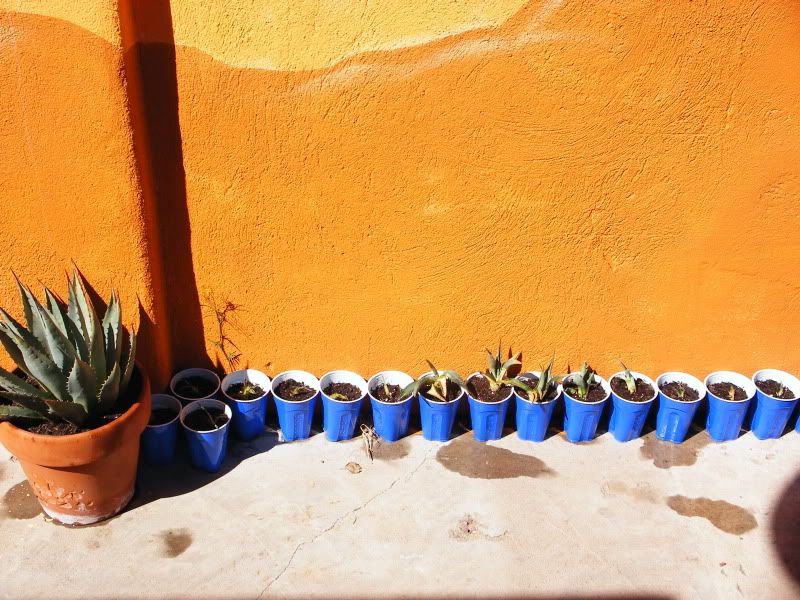
Now that the days are warm again and the Agave has survived my neglect for a whole year, I felt that it deserved some care.  With the help of my wife (who got stabbed instead of me) I've finally done it.


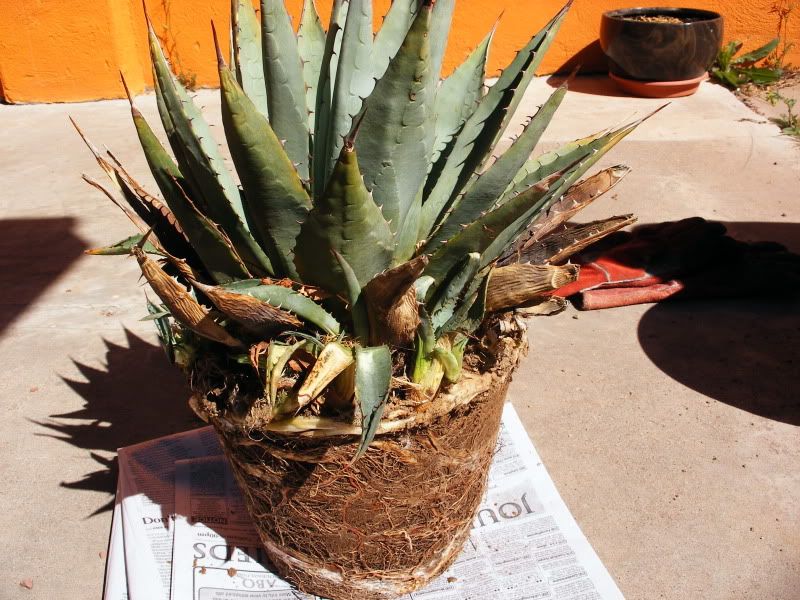
We started by removing the Agave from it's pot.  This took the form of a dangerous tug-of-war, myself gripping the dead leaves around the base while my wife struggled with the pot.  Once freed, it was apparent just how badly root bound the poor plant was.


I carefully began untangling roots, cutting off far more pups than I expected as I came across them.  The pups were attached to the parent plant by way of long ropey looking growths which I mostly cut off and discarded.

In the end I had eighteen pups, removed and potted in plastic ups (with holes in the bottoms, of course).  The Agave returned to it's original pot, it's roots trimmed down by about half.


Will any of these survive being manhandled?  I hope so.  When I feel certain which ones are going to survive, I will make another post here offering them up to any local gardener who cares to claim one.  I certainly don't have a need for so many Agave.

Tuesday, March 29, 2011

A Rose By Any Other Name...

...would still need pruning.

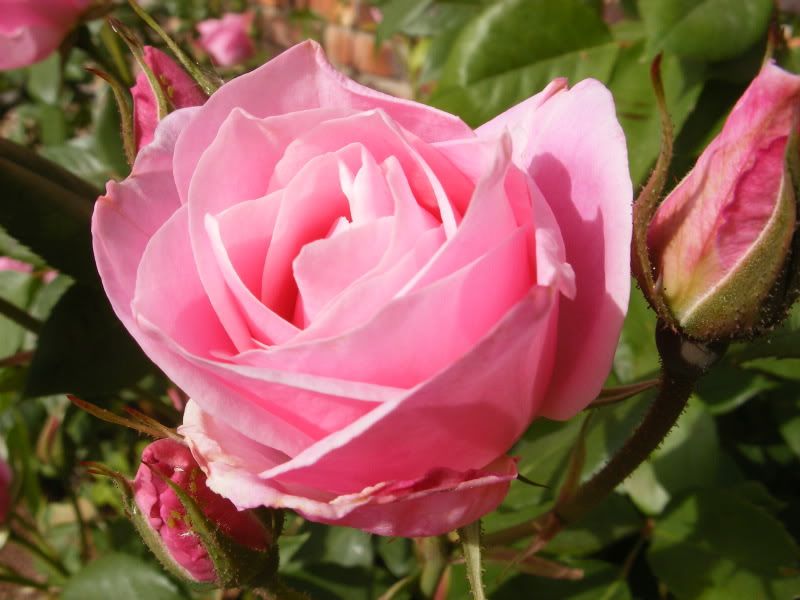
Allow me to say, before I go any further, that I don't know how to prune.  Really, I don't.  I know that it needs to be done.  I've seen how a good pruning can make plants healthier and more lovely.  Every time I try to prune, I read as much as I can find in the library about pruning that particular plant in an effort to do better.  I feel like, when I have to prune, I end up hacking off branches at random.  Fortunately, most plants seem more than capable of surviving a bad haircut.

A few years ago, home from college on spring break, I noticed that rose bushes in my girlfriend's parent's backyard.  They had, apparently, been planted by the house's previous tenants several years ago and had since lacked the attention they needed.  They were massively overgrown, sprawling up onto the roof of the house, a dense mess of  bramblous branches.  How I wish I had a photo of that wild mass of twisted branches.

Wanting to impress my future in-laws, and having just assisted my aunt with her masterful pruning the week before, I offered to do what I could to tame these rose-beasts.  Despite it being rather late in the year, I armed myself with welding gloves and my trusty bypass pruners and lopped off branch after branch.  I was terrified that the severity of my attack, combined with it's less than surgical nature, would send the plants into shock and kill them all.


It did not.  The roses sprung back, stronger than ever, in a profusion of blooms.

Last week marked the third year that I have picked a fight with those prickly plants.  Each year they seem more like rose bushes and less like a horticultural horror.  This year I filled three trash cans with the waste cuttings and the roses are already sending out new growth, preparing for the coming season.


The moral of the story: prune with enthusiasm!  Don't be afraid of butchering your plant.  Odds are good that it will survive your ineptitude, as the plants in my care continue to survive mine, and you can attempt to fix any mistakes next year.

Wednesday, March 23, 2011

A Birthday Planting

I have a friend who lives down in Aid, an hour south of Duke City.  Much like myself, he has a fascination with growing things and regularly plants gardens.  He also tends to move frequently, abandoning his gardens before they can provide him with much.  Last weekend I got a chance to go visit him, just after his birthday.  I thought a nice present might be a pot planted with a small tomato and herbs.

When I brought the idea up over lunch, he was enthused, but didn't show a particular interest in the pot.  Instead he wanted his plants in the ground.  We took a look at his place, evaluating it's potential, and at the selection of seeds and plants that the small city's stores could provide us and came up with a plan.

There was a deserted flower bed in front of his house which he wanted full of flowers.  There was an empty side yard he thought should be full of produce.  There were also some trellises affixed to the fence bordering his backyard that he thought needed adornment.  The soil, of course, was little more than sand.  Having one afternoon, no tools besides a folding shovel and a broom handle, and a small budget, this present had become quite a challenge.  At the local Walmart we grabbed some seeds, a flat of marigolds, as many bags of soil amendments as I thought I could buy, and a seed starting kit for the vegetables that couldn't be planted yet.

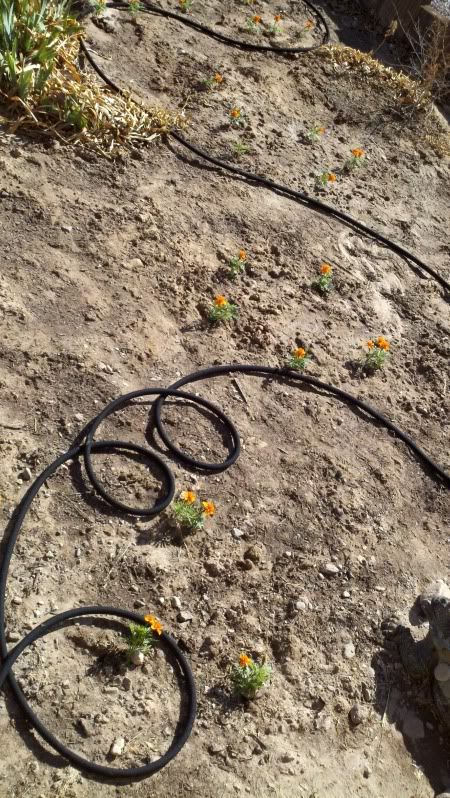
We dug up the flower bed in the front, weeding and turning in bags of soil as we went.  Marigolds were spaced out and planted, as was a packet of Nasturtium seeds.  The Marigolds looked looked like the best plants for taking some heat and neglect.  I've never grown Nasturtiums I've been wanting to try them (since I've read that they're edible) and their color matched the Marigolds.  The bed looks a little sparse right now but I hope that once the seeds sprout it will fill in and look rather cheery.

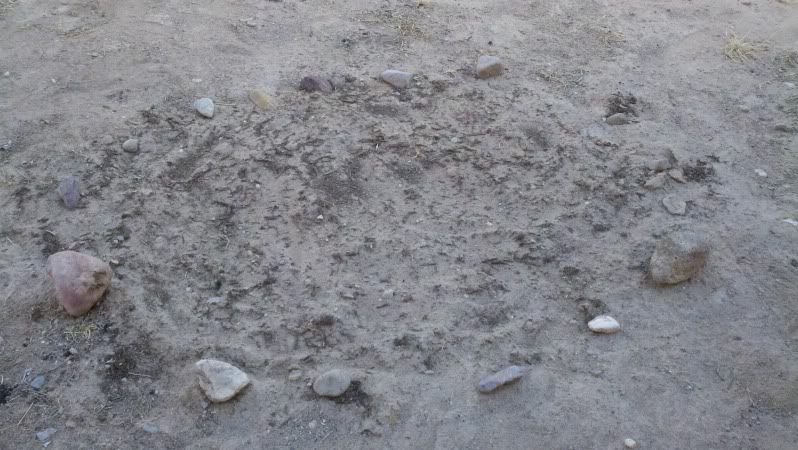
The side yard had a small circle dug up and lettuce seed broadcast into it.  I surrounded it with some stones so that my friend would know which part of the sand pit to water.  The trellises along the back got some blue morning glory seeds planted beneath them.  My last apartment had some Morning Glories climbing up the fence during the summer, which I though were very nice until I visited the Botanical Gardens and saw their bright blue variety.  They were stunning and hope these do just as well for my friend.

Inside, drinking water and cooling down, we prepared the seed starting tray.  Twelve peat pellets were planted with Garlic Chives, twelve with Sweet Basil, and twelve with Flat-leafed Parsley.  A full thirty-six got divided between Roma Tomatoes and some slicing hybrid that I can't recall.  I've never had much luck with those seed starters so I can't hazard a guess at how many plants it will actually produce.  However, my friend says there's no such thing as too many tomatoes.  I would love to see him in August if all thirty-six reach maturity.

Friday, March 18, 2011

The Hardest Time of the Year

March is such a cruel month in Duke City.  It's still technically winter and yet the weather has turned beautiful.  It's sunny and breezy and warm enough to be outside in a t-shirt.  The trees are flowering and sending out new growth.  Every inch of my body screams to get outdoors and start planting.  And yet I have to wait to plant most of my favourite vegetables.  I know that, come Easter, there will be one last hard freeze that will wipe out any tender greens.


Still, I can't help but get something in the ground.  This year, that means two different plantings.  There are two pots on the patio that now have sugar snap peas planted in them.  And one flower bed that I raked black spanish round radish seeds and a rainbow blend of carrot seeds into, with the promise that they will be finished and gone before my mother-in-law wants to plant flowers there.


And they're starting to come up!  Oh, the optimism of spring. Peas are beginning to push through the potting soil and a full dozen radishes are sunning their cotyledon.  Maybe, if I'm lucky, there will be as much radish growth underground as above and the carrots will follow suit, unlike last year.  I have no real logical reason to suspect that it will be so.  Quite the opposite, in fact, but I can't help it when the weather turns this nice.  I have to believe in spring!